When Did the Anaconda Plan Start
The Anaconda Plan was developed at the beginning of the American Civil War. It was the Union’s strategic plan to defeat the Confederacy.
Why Did the Union Call it the Anaconda Plan
The main purpose of the Anaconda plan was to defeat the rebellion by blockading southern ports and controlling the Mississippi river. This would cut off and isolate the south from the outside world.
An Anaconda is a snake that squeezes and suffocates it’s victim. The Anaconda Plan was designed to do the same thing, it was a great snake that would surround and squeeze the Confederacy into submission. The Anaconda Plan map drawn in 1861 shows how it would have worked.
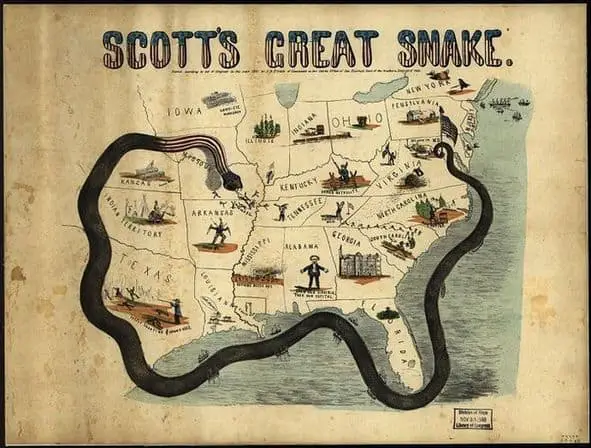
The Anaconda Plan drawn in 1861
Who Developed the Anaconda Plan
The plan was developed by General Winfield Scott at the beginning of the Civil War following the Confederate attack on Fort Sumter on April 12th 1861.
Why Was the Anaconda Plan Important
It was important because the strategic plan would have eventually ended the Civil War, ideally with minimal casualties on both sides.
It was a humanitarian way of defeating the rebellion as opposed to invading the south with massive numbers of troops, killing, burning and capturing everything in sight.
General Scott’s Anaconda Plan was a very passive way of defeating the Confederacy.
The problem General Scott had with his idea wasn’t the rebels. His problem was convincing fellow Union commanders that this was a good idea.
Pretty much all of the Union commanders disliked this plan and referred to it as being too complacent.
They wanted to attack the south and defeat them with the Union’s overwhelming military and industrial might.
General Scott’s plan would require patience and time. The other generals wanted to crush the rebellion quickly and permanently as soon as possible.
For an in-depth look at the tactics of the Civil War a great book is the #ad Atlas of the Civil War: A Complete Guide to the Tactics and Terrain of Battle

Complacent or not, the plan, if allowed full implementation and support from Northern military commanders would have saved many lives.

Creator of the Anaconda Plan General Winfield Scott during the Civil War
Theoretically if the plan was implemented at the start of the war the giant battles fought later in the war may never have happened.
The south would have been slowly deprived of food and supplies by the Union blockade. Union armies would have taken up defensive positions in the North repelling any Confederate attacks.
The Union would have slowly and methodically cut the Confederacy in half by taking the Mississippi river and the rebellion would have withered on the vine from a lack of food and supplies and forced to surrender.
Key Elements in the Anaconda Plan Timeline
The Anaconda Plan consisted of two main objectives:
- Naval blockade of all Confederate ports on the Atlantic coast and in the Gulf of Mexico
- Capture the Mississippi river in order to cut the Confederacy in two
Blockading all southern ports would cut off all trade to and from the rebellious states which would eventually cripple their economy.
The second objective of the plan was to transport roughly 60,000 Union troops in 40 steam transports escorted by upwards of 20 steam gunboats down the Mississippi river. Union troops would capture and hold forts and towns all along the Mississippi.
After these forts and towns along the Mississippi were captured, reinforcements would be sent to fortify and secure these areas. Troops would secure the Mississippi river down to the Gulf of Mexico which would link up with and keep their lines of communication open with the ongoing naval blockade.
The federal troops along the Mississippi river would be in a strong defensive position which would make it impossible for any Confederate forces to defeat them.
Capturing the Mississippi river would cut the Confederacy in half. Along with the naval blockade the Confederacy would be completely surrounded and cut off.
It would not be a quick victory but given enough time it had a chance of being successful. This was a good plan but it was never given the opportunity to be put into action.
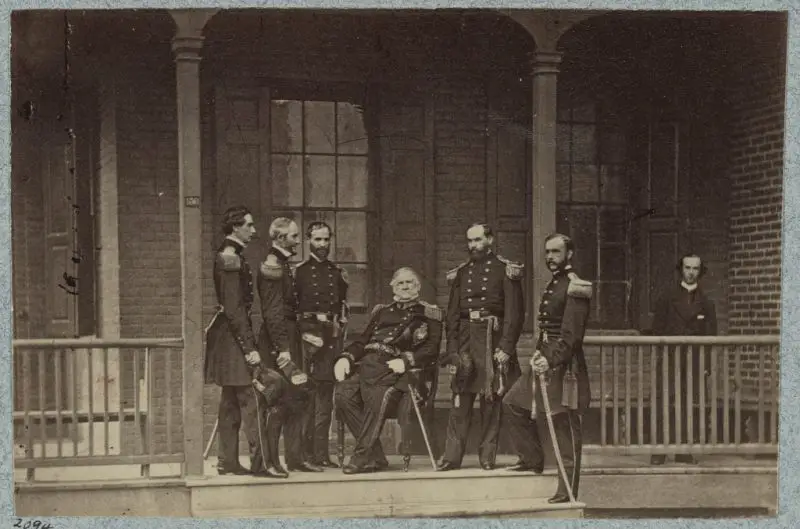
General Winfield Scott and Staff Officers
General Winfield Scott’s Plan Was Rejected
Many people did not approve of the anaconda plan seeing it as too passive and slow to implement.
General George McClellan had a different idea and came up with his own plan. He wanted to raise an army of 80,000 men in Ohio (he was the military commander in Ohio at this time) and send them on an overland campaign through Virginia and capture Richmond.
Many people however including President Lincoln, Union generals, and most civilians believed all they needed to do was
- Raise an Army in Washington DC
- Invade Virginia
- Win One Decisive Battle
- Capture the Confederate Capital of Richmond
- War Would Be Over in a Few Weeks
These ideas were rejected by General Scott in favor of the Anaconda Plan.
President Lincoln Ordered Attack
This aggressive and optimistic plan was actually carried out. An army was raised in Washington DC and this army commanded by General Irvin McDowell triumphantly marched into Virginia.
The army even had civilians following along hoping to see a great battle which would lead to the inevitable Confederate defeat.
The Union army and civilians did get their decisive battle. July 21st 1861 was a beautiful sunny day, the civilians following the Federal army laid out blankets and sat casually on the grass.
People set up picnics, chatted, and had some laughs. They were eagerly anticipating the victory of the Union army which would ultimately lead to the end of the Confederacy. It was all very exciting.
As the battle began excitement was in the air. As the battle continued the excitement began to turn into concern, followed by some anxiety, and then horror.
This brand new army was rapidly running back toward the lounging civilians. People quickly realized the entire army was running away, the bystanders were now in the way getting tangled up with the retreating troops.
The surprise and panic of this defeat was so great the troops along with their civilian followers didn’t stop running until they got back to the safety of Washington.
This battle became known as the First Battle of Bull Run also known as First Manassas. It was a decisive Confederate victory.
A book that takes a look at the Civil War using maps is #ad The Civil War: The Story of the War with Maps

Problems With the Anaconda Plan
General Scott retired at the end of 1861 and his subordinate General George McClellan took over command of the Union army.
The Anaconda plan was a good idea in theory however it would have been difficult for it to have actually succeeded in it’s original form.
While the Union navy did set up a blockade at the start of the rebellion, it was not strong enough at the beginning of the war to adequately blockade the entire south.
The naval blockade alone would not have defeated the rebellion, even if the Union also controlled the entire Mississippi river.
Confederate leaders were also not going to stand by and do nothing as the Union tried to starve them into submission.
The Confederacy had a strong army and was more than capable of taking on the Union army especially at the beginning of the war.
The Anaconda Plan Revisited
The Union looked to put an end to the war as quickly and decisively as possible. The tactics that were eventually used were reminiscent of Scott’s plan yet they also involved horrific combat.
After a long siege General Ulysses S. Grant captured the city of Vicksburg on July 4th 1863 giving the Union control of the Mississippi river and effectively cutting the Confederacy in two.
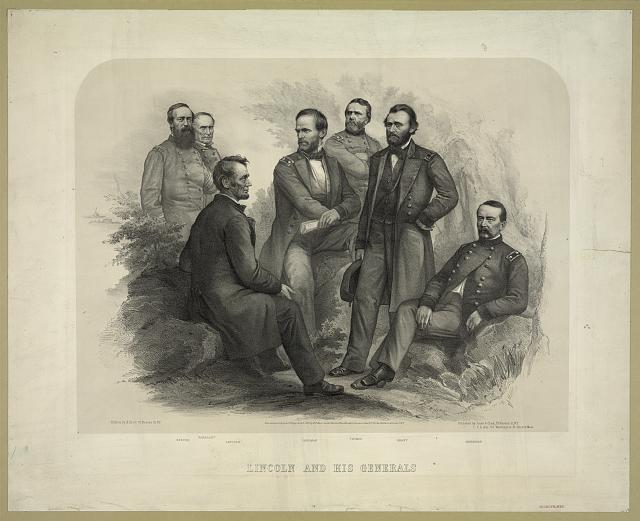
Abraham Lincoln with his generals
General William Tecumseh Sherman led his army on a rampage through the south during his march to the sea in 1864 depriving the south of vital food and materials as he and his men destroyed or captured anything that stood in their way.
This included the burning of Atlanta Georgia in 1864.
These victories coupled with the big battles in the north and the always increasing strength of the Union blockade eventually forced the Confederates to go completely on the defensive.
This inevitably resulted in their defeat and the crushing of the rebellion.
Whereas with General Scott’s plan for a more peaceful resolution to the rebellion, General Grant, General Sherman and the other Union commanders accomplished virtually the same things as the Anaconda plan proposed.
The main difference being brutal combat and many casualties on both sides.
Was the Anaconda Plan Successful
The original strategic plan was a failure, as it was never given the support it required to succeed.
However in the end, the general framework of the plan was a major contributing factor that brought about the surrender of the Confederacy and the end of the American Civil War.