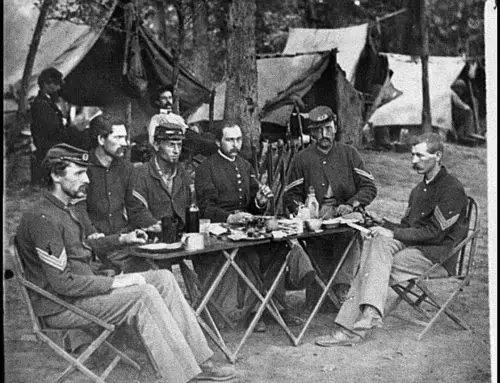
(1809-1865)
Abraham Lincoln Timeline – 1809
February 12 – Abraham Lincoln was born in a one-room log cabin, near what is now Hodgenville, Kentucky. His parents were Thomas (a carpenter by trade; a farmer out of necessity) and Nancy Hanks.
Lincoln had one sister, Sarah, who was 2 years older and a brother who died in infancy. Today, the birthplace is located at the Lincoln Birthplace National Historic Site.
1811
The family moved several miles away from Abraham’s birthplace to a farm on Knob Creek.
1816
December – The Lincoln family moved to Indiana, settling near present-day Gentryville. Nancy Hanks’ aunt and uncle (the Sparrows) and their foster son Dennis Hanks come at a later date.
1818
October 5 – Lincoln’s mother, Nancy Hanks Lincoln, died of milk sickness. The burial place is preserved in the Lincoln Boyhood National Memorial in Spencer County, Indiana. The Sparrows died the same year.
December 13 – Mary Ann Todd, future wife of Abraham Lincoln, was born.

Abraham Lincoln (1809-1865)
1819
December 2 – Thomas Lincoln re-married in Elizabethtown, Kentucky. Sarah Bush Johnston brought her 3 children from her previous marriage into the Lincoln family: Elizabeth, Matilda, and John. Abraham Lincoln had a wonderful relationship with his stepmother.
1825
Mary’s mother dies.
1830
March 1-15 – The Lincoln family moved to Illinois and settled in Macon County near what is now Decatur.
1831
July – Abraham Lincoln left his family and arrived in New Salem. He was 22 years old. While in New Salem, he worked as a clerk in one store and became part owner of another store that eventually failed, was a postmaster, and also a surveyor. While in New Salem, it appears he was romantically involved with two women- Mary Owens and Ann Rutledge. The relationship with Mary Owens seems to have been serious, as Abraham had intentions of marrying her. His relationship with Ann Rutledge is less clear, but apparently serious enough to drive Lincoln into deep depression when she died.
1832
April 21 – Abraham Lincoln enlisted in the local militia, the Thirty-First Regiment of Illinois, following the governor’s call for troops at the breakout of the Blackhawk War. He served for 51 days but witnessed no action. His fellow militiamen elected him as their captain, an honor he said which gave him “more pleasure than any I have had since.”
August – Abraham Lincoln’s political aspirations begin when he was defeated in a run for a seat in the Illinois General Assembly as a candidate for the Whig Party. He finished eighth in a field of thirteen candidates.
1834
August 4 – Abraham Lincoln was elected to the Illinois General Assembly for the first time, representing Sangamon County, which was much larger than it is today. He ran as a member of the Whig Party. This was his second attempt to gain a political office.
1836
August 1 – Lincoln was re-elected to his seat in the state legislature. Lincoln was a member of the “Long Nine,” a group of 9 Whig party members elected from Sangamon County noted for their height. The Long Nine were noted for their successful work in having the state capital moved from Vandalia to Springfield.
Abraham Lincoln received his license to practice law from the Illinois Supreme Court on September 9, 1836.
Lincoln filed his first law suit on October 5, 1836.
1837
April 15 – Abraham Lincoln arrived in Springfield with all of his belongings in two saddlebags. He arranged to share a room with Joshua Speed, a Springfield store owner. He was 28 years old.
April 15 – Abraham Lincoln officially became the junior law partner of John Todd Stuart, Mary Todd Lincoln’s cousin.
Mary visits Springfield for the first time.
1838
August 6 – Lincoln was re-elected for a third term in the Illinois General Assembly again, as a member of the Whig Party.
1839
September 23 – Lincoln began traveling the Eighth Judicial Circuit. He continued to ride the circuit until his election to the Presidency.
Mary returns to Springfield and lives with her older sister Elizabeth, who was married to Ninian Wirt Edwards, son of Illinois Territorial Governor Ninian Edwards.
Abraham Lincoln met Mary Todd at a ball.
1840
Abraham Lincoln and Mary begin courting.
August 3 – Lincoln was re-elected for a fourth term in the Illinois General Assembly.
1841
January 1 – Lincoln and Mary break off their engagement probably due to Elizabeth and Ninian Edwards’ disapproval of Lincoln.
April 14 – Lincoln’s partnership with John Todd Stuart ends. At this time, he became a law partner with Stephen T. Logan.
1842
Lincoln and Mary begin courting in secret.
November 4 – Reverend Charles Dresser marries Lincoln and Mary in the home of Ninian and Elizabeth Edwards (Mary’s sister). Lincoln was 33 years old; Mary was 23.
November 5 – The Lincolns rent a single room on the second floor of the Globe Tavern rooming house. The Globe Tavern was located on Adams Street between Third and Fourth Streets.
1843
August 1 – Robert Todd Lincoln, their first son, was born at the Globe Tavern rooming house.
The Lincoln family (Abraham, Mary, and Robert) briefly rented a small cottage on Fourth Street between Adams and Monroe Streets.
1844
January 16 – Lincoln purchased his first and only home from the Reverrend Charles Dresser for $1,500, $1,200 cash plus a lot valued at $300
May 1 – The Lincoln family (Abraham, Mary, and Robert) moved into the home on Eighth and Jackson Streets.
Lincoln sets up his own law practice with William H. Herndon as his junior law partner.
1846
March 10 – Edward Baker Lincoln was born at the Lincoln Home.
August 3 – Abraham Lincoln was elected to a seat in the United States House of Representatives, as part of the Thirtieth Congress, as a candidate of the Whig Party. This was the only United States Congressional seat he ever held.
The first remodeling of the Lincoln Home occurred. The Lincolns added a bedroom and a pantry to the back of the home.
1847
Lincoln, Mary, Robert, and Eddie moved to Washington, D.C.
December 6 – Lincoln takes his seat in the United States House of Representatives.
1848
Mary and the boys depart Washington, D.C., in part, because Lincoln thought Mary “hindered me some in attending to business.” A few months later, Lincoln wrote that “having nothing but business – no variety” made life “exceedingly tasteless.”
1849
Lincoln proposes legislation in the United States House of Representatives to begin abolishing slavery in the District of Columbia.
The second remodeling of the Lincoln Home occurred during the years of 1849 and 1850. At this time, stoves were installed in the parlor rooms, the brick retaining wall in front of the home was constructed, and the front walk was bricked over, replacing the wooden sidewalk.
1850
February 1 – Edward Baker Lincoln died at the Lincoln Home after fighting an illness (probably tuberculosis) for 52 days. He was 3 years and 10 months in age.
December 21 – William Wallace Lincoln was born at the Lincoln Home.
1852
Mary becomes a member of the Presbyterian Church.
1853
April 4 – Thomas (Tad) Lincoln was born at the Lincoln Home.
The Lincoln Home was remodeled once again in 1853. It appears that the barn was added at this time.
1854
May 30 – The Kansas-Nebraska Act was passed. The passage of this act brought Lincoln back into politics.
November 7 – Lincoln was re-elected to the Illinois legislature , but withdrew from office 20 days later to pursue a run for the US Senate, a race he eventually quit. Lincoln dropped out of the race so that the Republican Party would be guaranteed a win for the Senate seat. He directed his support to Lyman Trumbull.
1855
February 8 – Lincoln loses bid for Senate seat.
The most noticeable remodeling of the Lincoln Home took place in 1855. It was at this time that the front of the home was raised from 11/2 stories to 2 full stories. The bedroom was moved to the upstairs portion of the home, allowing for the creation of the rear parlor. The wood folding doors were added to the parlor at this time and the front parlor windows were permanently closed.
1856
The fifth remodeling of the Lincoln Home took place in 1856. The rest of the home was raised to 2 full stories. The iron railing was added to the second floor porch and a wall was put in place to separate the kitchen and dining room.
1858
June 16 – After the Illinois State Republican convention unanimously selects him as their Senate candidate, Lincoln delivers his “House Divided Speech.”
In 1858, Lincoln made another run for the US Senate, running against Stephen Douglas. The campaign for this seat in 1858 sparked the famous Lincoln-Douglas Debates. There were 7 debates, one in the following towns:
1) Ottawa- August 21, 1858
2) Freeport- August 27, 1858
3) Jonesboro- September 15, 1858
4) Charleston– September 18, 1858
5) Galesburg- October 7, 1858
6) Quincy- October 13, 1858
7) Alton- October 15, 1858
On November 2, 1858, Lincoln lost the Senate race to Stephen Douglas. The Republicans received 125,000 votes and the Democrats received 121,000 votes. However, due to legislative apportionment and thirteen holdover Senators, the Democrats have a majority of Senators in the State Legislature which chooses the next United States Senator from Illinois.
1859
Illinois legislature chooses Douglas for the U.S. Senate over Lincoln by a vote of 54 to 46.
The final alterations of the Lincoln Home took place in the latter part of 1859 and the beginning of 1860. The backyard washing house was torn down and the woodshed was added to the existing Lincoln barn.
1860
May 18 – Lincoln was chosen by the Republican National Convention in Chicago to represent the party in the 1860 Presidential election.
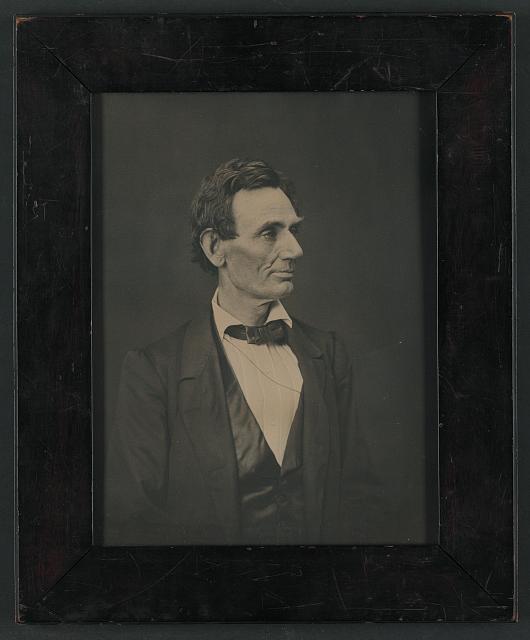
Abraham Lincoln Presidential Candidate
October 19 – Lincoln received the famous Grace Bedell letter. Grace was an 11-year old girl from Westfield, New York. After apparently taking Grace’s advice, Abraham Lincoln became the first bearded President.
November 6 – Abraham Lincoln was elected the 16th President of the United States defeating Stephen Douglas (Northern Democratic Party), John C. Breckinridge (Southern Democratic Party), and John Bell (Constitutional Unionist Party). His Vice President was Hannibal Hamlin of Maine.
December 20 – South Carolina becomes the first state to secede from the Union.
1861
February 4 – The Confederate States of America was established. Jefferson Davis was selected as president and Alexander Stephens as vice president.
February 11 – Lincoln gave his Farewell Address to Springfield, just a day before his 52nd birthday. The journey to Washington D.C. took 12 days.
March 4 – Abraham Lincoln is inaugurated as the sixteenth President of the United States. Delivers First Inaugural Address.
April 12 – The Civil War began with the attack on Fort Sumter, South Carolina, by the Confederacy.
April 14 – Fort Sumter surrenders.
April 15 – Lincoln issues a call for 75,000 volunteers.
June 3 – Stephen Douglas died in Chicago at the age of 48. Following his death, Lincoln initiates a mourning period of 30 days.
July 21 – Battle of First Manassas. Confederate victory.
1862
February 20 – William Wallace Lincoln died at the White House, probably of typhoid fever. He was 11 years old. His remains were interred at Oak Hill Cemetery in Georgetown until 1865.
August 30 – Battle of Second Manassas. Confederate victory.
September 17 – Battle of Antietam. Inconclusive (Union strategic victory)
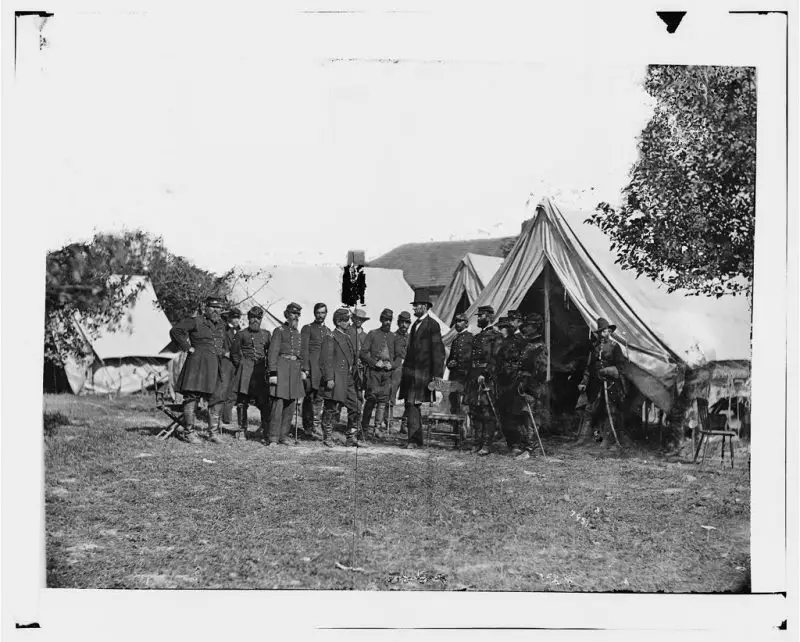
Abraham Lincoln with George McClellan and staff at Antietam
September 22 – Lincoln issues preliminary Emancipation Proclamation.
1863
January 1 – Lincoln issued final Emancipation Proclamation.
July 1 – 3 – Battle of Gettysburg. Union victory.
July 4 – Battle of Vicksburg. Union victory.
November 19 – Abraham Lincoln delivered his Gettysburg Address at the dedication of Gettysburg National Cemetery.
1864
February 22 – The National Union Party (a temporary name for the Republican Party used to spark interest in the notion of a once-again United States) convention in Baltimore nominated to Lincoln for re-election.
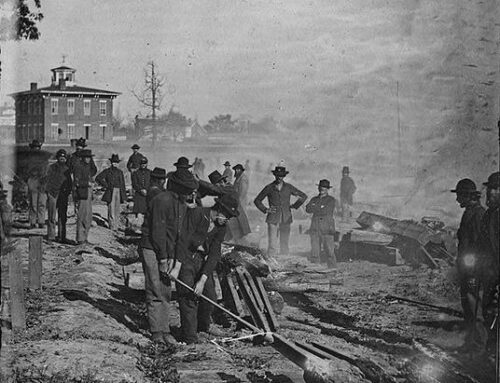
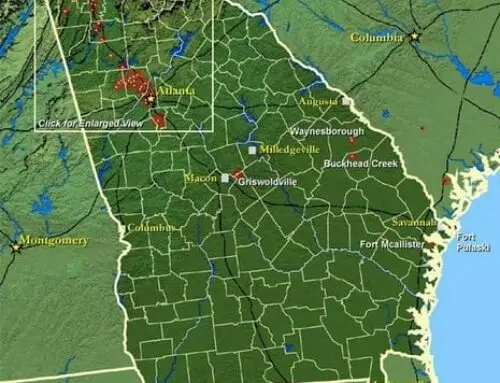
September 1 – Union forces took control of the city of Atlanta, Georgia.
November 8 – Lincoln was re-elected to the Presidency defeating General George B. McClellan. Lincoln’s Vice President was Andrew Johnson.
December 22 – General William T. Sherman presented the captured city of Savannah, Georgia, to Abraham Lincoln as an “early Christmas gift.”
1865
March 4 – Lincoln delivered Second Inaugural Address.
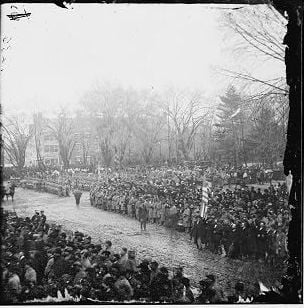
Abraham Lincoln Second Inauguration
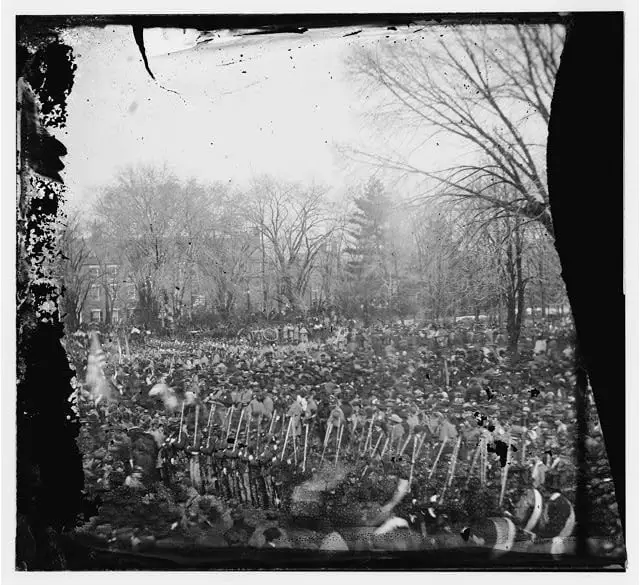
President Lincoln Crowd at Second Inauguration
April 9 – The Civil War officially ended, with the surrender of the General Robert E. Lee’s Army of Northern Virginia at Appomattox Court House, Virginia.
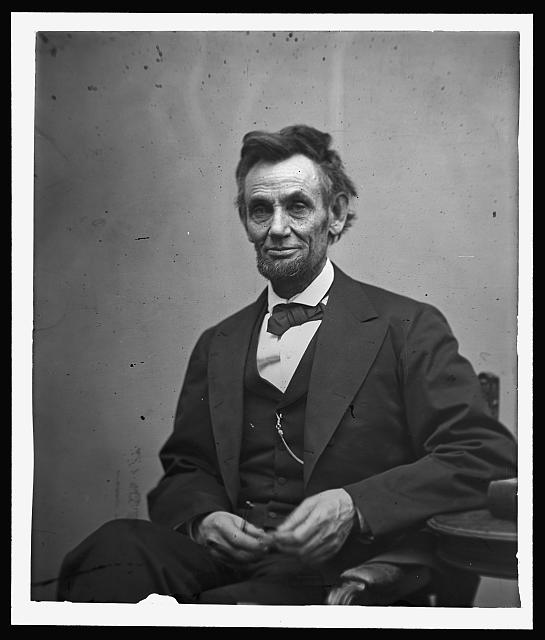
President Abraham Lincoln 1865
April 14 – John Wilkes Booth shoots President Lincoln in Ford’s Theater while watching the play Our American Cousin.
April 15 – Lincoln Assassination – Abraham Lincoln died at 7:22 a.m. in the Petersen Boarding House. He was 56 years old.
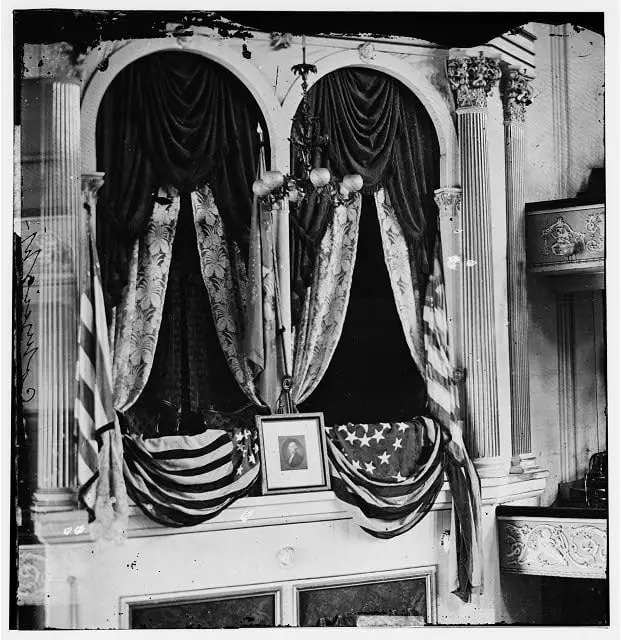
Abraham Lincoln’s Box at Ford’s Theater
April 19 – Funeral services for Abraham Lincoln were held in the White House.
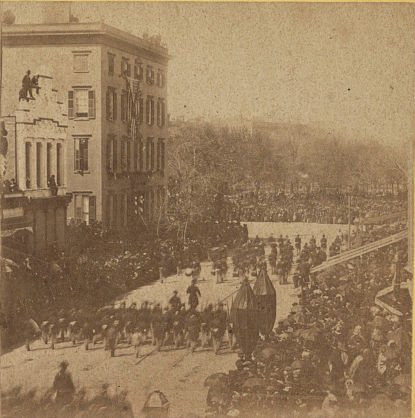
Abraham Lincoln Funeral Procession
April 21 – The Funeral Train, with Lincoln’s remains and those of his son Willie, departed Washington, D.C. beginning a 12-day trip back to Springfield, Illinois.
May 3 – The Funeral Train arrived in Springfield. Lincoln’s remains were laid in state at the Old State Capitol.
May 4 – Lincoln’s remains were interred at Oak Ridge Cemetery.
May 22 – Mary Lincoln departed the White House.