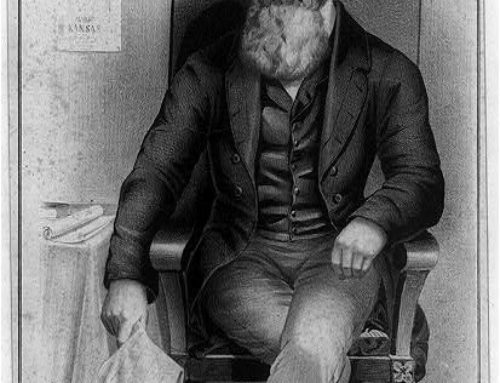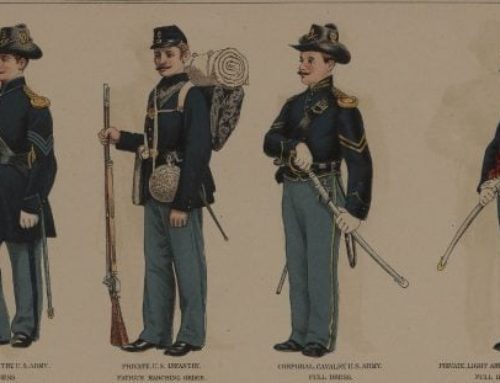
James Ewell Brown (Jeb) Stuart (1833-1864) was born on February 6, 1833 Stuart enrolled at the the US Military Academy at West Point and graduated in 1854. His first service was the 1st US Cavalry in the Kansas territory, though he was transferred east in 1859.

Confederate cavalry leader Jeb Stuart
Jeb Stuart at Harper’s Ferry
On October 16th 1859 John Brown and 18 abolitionist raiders attacked Harper’s Ferry seizing the armory and arsenal. For eighteen hours they built up defenses, took hostages, and cut telegraph lines. Citizens and local militia fought the raiders finally forcing them into the fire engine house.
Late on October 17th a detachment of 90 US marines arrived at Harper’s Ferry led by Colonel Robert E. Lee along with Lieutenant Jeb Stuart. At 7:00 am Jeb Stuart approached the engine house and handed the raiders a letter demanding their surrender. If they surrendered their lives would be spared.
Brown refused the offer to surrender. The marines stormed the engine house and after a brief fight captured John Brown and his surviving men.
Here is the actual letter Jeb Stuart gave to the abolitionists raiders demanding their surrender.
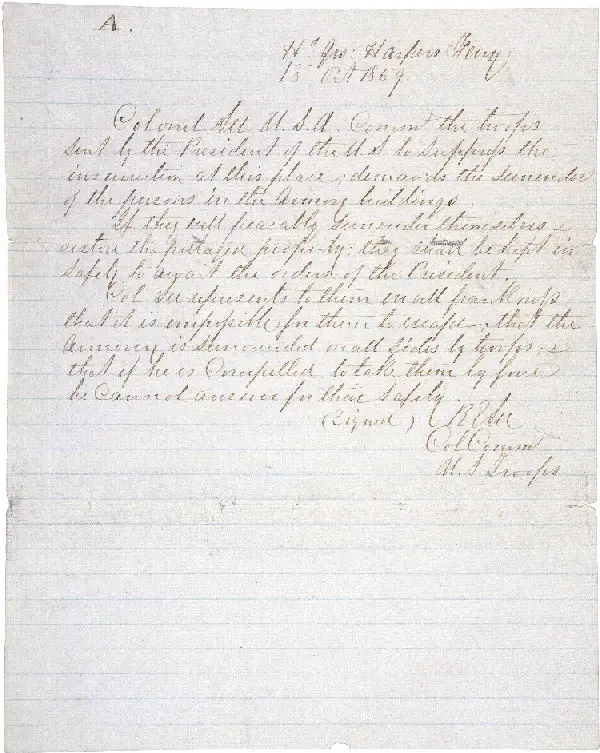
Harper’s Ferry Surrender Demand Letter
Jeb Stuart Accomplishments
When the Civil War broke out in 1861, Stuart resigned his commission with the United States Army and offered his services to Virginia. He was given the rank of colonel of the 1st Virginia Cavalry and assigned to the Shenandoah Valley.
Stuart’s wartime career was marked by spectacular exploits that made good newspaper articles for Virginia. Jeb Stuart made a name for himself at the first Battle of Bull Run where his cavalry swept down on retreating Union soldiers.
He was promoted to brigadier general in September, 1861, and given a brigade of cavalry to command in the Army of Northern Virginia. During the Seven Days Battle near Richmond, Stuart and his command succeeded in riding all the way around the Union Army. His ride became the subject of many news stories and a song called “Riding A Raid”.
In July, 1862, General Jeb Stuart became a major general and was assigned to command the cavalry force in Lee’s army.
The general loved parties and gloried in being the center of attention. At every opportunity his staff would arrange dances and parties at homes that they decorated with flowers, ribbons, and crossed sabers. His camp attracted many officers who modeled themselves after the dashing Stuart.
The general wore a plumed hat and fancy jackets adorned with brass buttons and gold lace trim. Many of his officers dressed in a similar fashion after their commander. Stuart also loved songs, poems, and a good joke, some of which he played on his infantry commander, General Thomas “Stonewall” Jackson.
The two officers worked extremely well as a team and Stuart used his cavalry to not only scout for Lee’s army, but to strike at Union supply lines and outposts at will. As the war carried on, Stuart’s adventures became famous in the North as well. Few Union officers were comparable in the use of mounted troopers.
What Happened to Jeb Stuart at Gettysburg
Jeb Stuart was not perfect however and even his most ardent admirers had a difficult time defending the general’s actions during the Gettysburg Campaign.
General Lee’s orders to Stuart gave the cavalryman some leeway, so he took advantage of a confused situation to raid Union supply lines and ride northeast around the Army of the Potomac into Pennsylvania. This happened while Lee moved his Army of Northern Virginia up the Shenandoah Valley and into Maryland and Pennsylvania.
Separated by about 80 miles, Lee had no way of telling where Stuart was. Nor could Stuart use his cavalry to be Lee’s “eyes and ears” to inform him of where the Union army was.
General Stuart did not arrive at Lee’s headquarters until late on the second day of the Battle of Gettysburg. General Lee openly expressed his displeasure at Stuart for riding off and not keeping in contact with the army.
On July 3rd 1863 General Stuart moved his cavalry division eastward to attempt to get around the Union right flank and raid the Union army’s supply lines.
He was stopped and defeated in a pitched battle with Union cavalry led by George Armstrong Custer three miles east of Gettysburg that afternoon. General Stuart’s troopers covered the army’s retreat back to Virginia and despite the controversy of his actions, Stuart was able to recover his reputation over the next six months.
When the spring of 1864 arrived, General Stuart found himself facing a new Union cavalry commander, General Philip H. Sheridan. Sheridan was ordered by General Grant to lead a raid upon Richmond while the Union army fought Lee’s army in the Battle of the Wilderness that May.
When Did Jeb Stuart Die
On May 11th 1864 Jeb Stuart and his cavalry were regrouping at an old abandoned building called Yellow Tavern about 6 miles from Richmond. Sheridan’s cavalry suddenly arrived at Yellow Tavern surprising the Confederate cavalry.
A sharp battle ensued, Stuart shouting and directing his men from his horse was shot in his stomach by a retreating Union soldier using a pistol. The bullet exited through Stuart’s back. Jeb Stuart was quickly taken to a hospital in Richmond.
Stuart asked his doctors how long he would survive. Despite their best efforts they had no choice but to inform Stuart the wound was fatal and death was rapidly approaching.
Confederate President Jefferson Davis visited Stuart and stayed with him awhile.
Stuart became delirious at times, his mind raced between thoughts of past military achievements and his wife and family. He desperately wanted to survive long enough to see his wife one last time. His wife was quickly informed by telegraph that her husband had been wounded. The message sent simply said Stuart was slightly wounded, the sender did not want to worry her too much. This unfortunate wording delayed her arrival at his side.
After enduring many hours of delirium and intense pain, Stuart continually asked if his wife had arrived yet, but always received the same answer of no.
No longer able to hold on Jeb Stuart died on the evening of May 12th 1864 at 7:38 pm. A little over a day after being shot.
What Were Jeb Stuart’s Last Words
Jeb Stuart’s last words were “I am going fast now, I am resigned, God’s will be done.”
Jeb Stuart’s sword was left to his son. Stuart is buried in Hollywood Cemetery in Richmond. His passing marked a turn of fortunes for the Confederate cavalry of Lee’s army, and he is still admired today as one of the greatest cavalry commanders of the Civil War.